Wi-Fi 7: What It Means for High-Density Wireless
Wi-Fi 7 (IEEE 802.11be) is the first generation that treats capacity per access point, not headline speed per device, as the design target. For venues that pack many concurrent clients onto a limited number of radios — hotels, campuses and smart buildings — that is the metric that actually decides whether a rollout feels dense and sluggish or consistently responsive. This article looks at what changes in practice, why high-density environments benefit most, and how Rayfond's indoor and outdoor access points cover the upgrade path.
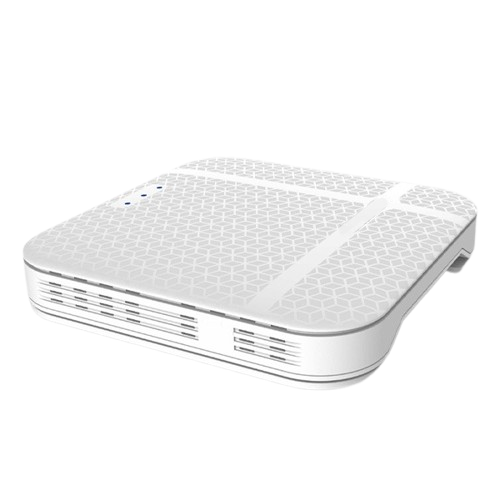
Why high-density wireless is the real test
Conventional rating focuses on a single client far from the dashboard. The challenge in a lobby, lecture block or smart-building sensor mesh is different: scores of devices — phones, laptops, check-in terminals, cameras and IoT — sharing each radio with bursty, short transfers mixed with a few heavy streams.
Under Wi-Fi 6 (802.11ax), contention handling improved and the network holds up better. But dense venues still hit bottlenecks when many clients compete for the same spectrum. Wi-Fi 7 addresses exactly this: it delivers more usable capacity per access point, so the ceiling moves from the radio to the wired network behind it.
What 802.11be changes under the hood
Three capabilities do most of the work, and each maps to a planning decision:
- Multi-link operation (MLO) lets a device transmit on 2.4 GHz and 5/6 GHz links at the same time, raising throughput and adding redundancy. Worth little unless the radio layout makes both bands usable at the client location.
- Wider channels — including 320 MHz in the 6 GHz band — give each high-traffic coverage cell substantially more spectrum. They are scarce and need careful reuse planning, so they belong on busy cells, not every access point.
- Higher-order modulation and multi-resource-unit scheduling get more from the spectrum under contention, which is precisely what dense venues need.
The net effect is not only speed: it is steadier latency and throughput when the network is under load.
Access points that scale to the crowd
Product side, the decision is not just "Wi-Fi 6 or Wi-Fi 7". It is matching the right class of access point to each coverage cell. Rayfond's portfolio spans indoor and outdoor access points across both generations, so a site can standardise on Wi-Fi 7 where density is real today and keep Wi-Fi 6 units where clients and traffic are light.
Power matters as much as radio capacity in dense deployments. Wi-Fi 7 access points typically draw more power, and the ability to power them in-band keeps cabling simple: Rayfond access points support PoE++ (802.3bt), which lets a single uplink carry both data and power to the ceiling.
Choosing the right density class
Treat a Wi-Fi 7 rollout as a systems decision rather than an access-point swap:
- Backhaul and PoE budget: confirm the access layer delivers enough per-port power — PoE++/802.3bt — so high-traffic units do not brown out under load.
- Access-to-core path: more wireless capacity pushes more traffic upstream. The Access → Aggregation → Core design needs headroom, or added airtime simply queues at the switch.
- Client readiness: MLO and wide channels only help devices that support them. Plan for a mixed fleet — newer clients gain the full benefit, while Wi-Fi 6 and Wi-Fi 5 clients still connect normally through Wi-Fi 7 access points.
An ODM path for tailored rollouts
For system integrators, brand owners and project partners, density requirements differ by venue and market. As a Hong Kong-based network technology enterprise delivering data center switches, enterprise Ethernet switches and Wi-Fi access points, Rayfond supports end-to-end ODM custom development — from hardware specification and channel plan feedback to packaging and compliance — so a high-density wireless project can be shaped to the deployment rather than forced into a generic catalogue.
Takeaway
Deploy Wi-Fi 7 where client density and latency matter most, power the access layer with PoE++/802.3bt, and make sure the wired network can absorb the extra traffic. Rayfond's indoor and outdoor access points, spanning Wi-Fi 6 and Wi-Fi 7, give you a generation you can grow into — venue by venue.
Specific per-model capacity figures and power draw should be confirmed against the current datasheets where provided.